
Slider


Showing posts with label Japan. Show all posts
Showing posts with label Japan. Show all posts
Monday, 10 March 2025
Japan’s ASEV Super Destroyer: Fresh Details Unveiled
Read More ->>

Saturday, 12 January 2019
FLEETS #26: The Japan Maritime Self-Defense Force today
Written by D-Mitch
 |
| Maya-class destroyer (DDG); it entered service in 2020 |
Following Japan's defeat in World War II, the Imperial Japanese Navy was dissolved by the Potsdam Declaration acceptance. Japan's 1947 Constitution was drawn up after the conclusion of the war, Article 9
specifying that "The Japanese people forever renounce war as a
sovereign right of the nation and the threat or use of force as a means
of settling international disputes." The prevalent view in Japan is that
this article allows for military forces to be kept for the purposes of
self-defense. In 1954, the JMSDF was formally created as the naval branch of the Japan Self-Defense Forces (JSDF), following the passage of the 1954 Self-Defense Forces Law. The first ships in the JMSDF were former U.S. Navy
destroyers, transferred to Japanese control in 1954. In 1956, the JMSDF
received its first domestically produced destroyer since World War II, Harukaze. You can read more about The evolution of Japanese destroyers after WWII. This FLEETS
post is devoted exclusively to the Japan Maritime Self-Defense Force
today, one of the most powerful navies on the planet. The Japan Maritime Self-Defense Force (海上自衛隊 Kaijō Jieitai), JMSDF, also referred to as the Japanese Navy, is tasked with the naval defense of Japan. The JMSDF has a fleet of about 154 ships and 346 aircraft and consists of approximately 45,800 personnel. The first graph (G #1) includes all the carriers, submarines, destroyers, frigates, missile boats and naval aviation (ASW/SAR/MPA/ELINT) that will be in active service by February 2023 (UPDATED). The.. "offensive" force if I may say. Note that Japan is currently converting both 248-meter Izumo-class helicopter destroyers into real light aircraft carriers capable of operating the F-35B STOVL fighters!
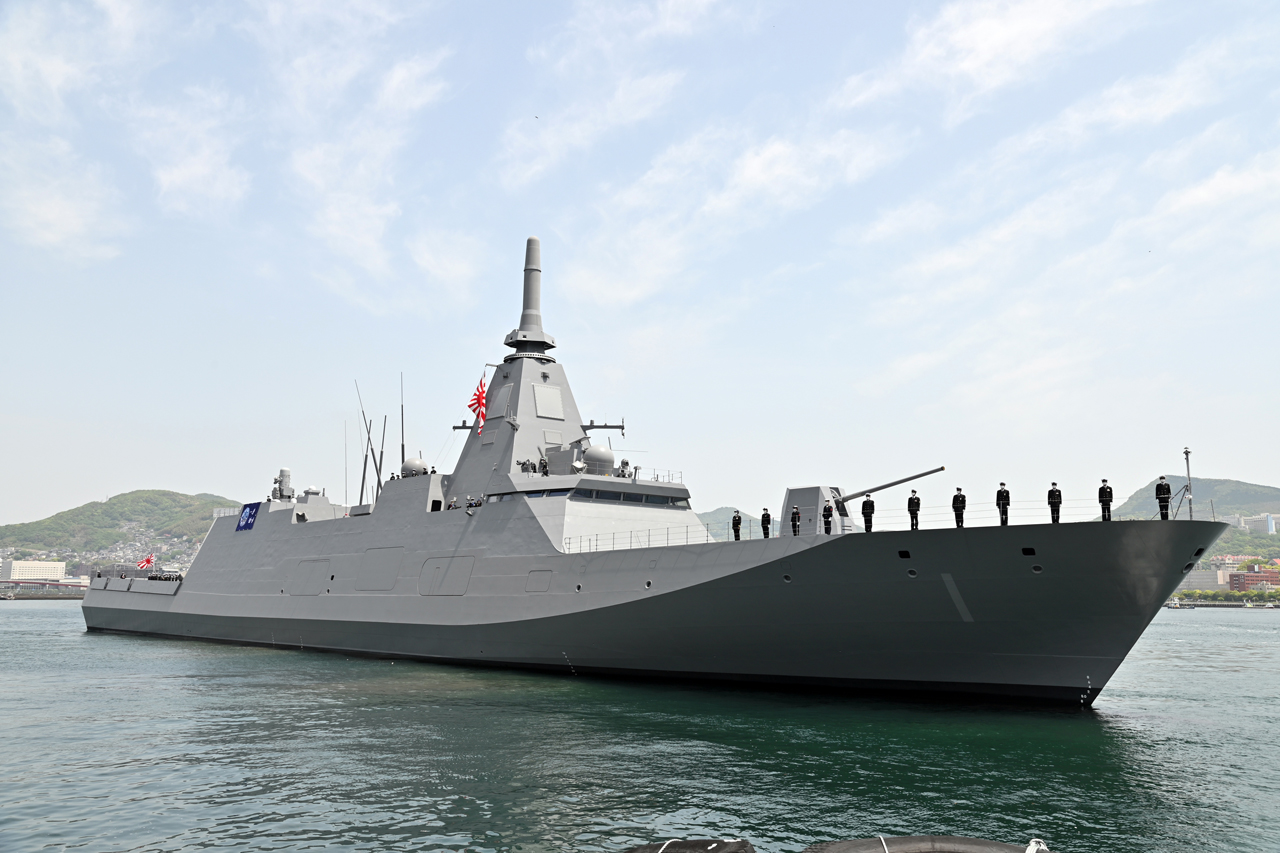 |
| The lead ship of the new class of multi-mission stealth frigates |
On August 31, 2022, the Japan Ministry of Defense announced that JMSDF will operate two massive 20,000-ton "Aegis system equipped ships" to replace the earlier plan of Aegis Ashore installations, commissioning one by the end of fiscal year 2027, and the other by the end of FY2028. According to the Defense Buildup Program that was published on December 16, 2022 the JMSDF will increase the number of Aegis-equipped guided-missile destroyers (DDG) from the current eight to ten, as well as two Aegis system-equipped vessels (ASEV) to be deployed in ballistic missile defense (BMD) operations. Therefore by the end of the decade, the JMSDF will operate 12 ships equipped with Aegis Weapon System (AWS) and likewise plans to replace its fleet of older, less capable destroyers and destroyer escorts with Mogami-class frigates.
Read More ->>
Friday, 20 October 2017
FLEETS #18: Italian Navy, Japanese Navy, French Navy (v.II) and Turkish Navy in WWI
The following images illustrate the most important classes of warships that were in service with the navies of Italy, Japan, France (version 2) and Turkey (Ottoman Empire) during the World War I. More posts will follow
for your collection of current naval fleets but also of fleets from the
past.
Italian Navy (Regia Marina) in WWI
 |
| Click to enlarge and save the image to view the details - Italian Navy in WWI |
Read More ->>
Tuesday, 28 June 2016
The evolution of Japanese destroyers after WWII
Article written by Jon Harris
Additional information, photos and graphs by D-Mitch
Additional information, photos and graphs by D-Mitch
 |
| JMSDF destroyers (DDG and DDH) in formation |
Since the end of World War Two, Japan has commissioned as many different destroyer type designs as the United States and the former Soviet Union. This exceptional feat has gone little noticed. The Japanese Maritime Self Defense Force (JMSDF) has produced a steady stream of gradually improving designs, culminating in the powerful, well-balanced fleet of today. Their design bureau didn't produce radical forms such as the Russian KYNDA class cruisers, or Swedish VISBY class corvettes. Rather, this island nation developed a variety of platforms designed to defend the homeland and its vital oceanic trade. The application of existing weapons and sensors, primarily of US origin, provided for robust growth, and limited expenditures on research and development.
Read More ->>
Tuesday, 28 July 2015
INFOGRAPHICS #16 and HISTORY #3: Battleships of WWII!
Written by D-Mitch
This article is devoted to the battleships, the most powerful ships to sail the waves and the pride of every navy from 1880 to the early '40s. These large warships with the impressive gun armament, the so-called "Castles of Steel" or "The Floating Fortresses", were a symbol of naval dominance and national might, and for decades the battleship was a major factor in both diplomacy and military strategy. The following image (compiled by iksanov) depicts individual battleships and battlecruisers of major battleship classes as they were in a specific year (camouflage, prior or after a modernization, etc.). The majority of them served during WWII with very few exceptions such as the España class battleship Jaime I (n.28) or the HMS Vanguard (n.2) that was commissioned in 1946 (I modified the original image because instead of Vanguard, it had the Sovetsky Soyuz-class battleship, a ship that was never completed and commissioned). Somebody can notice also that not all the battleship classes are included, such examples are the Conte di Cavour class of Italy, the New Mexico and Pennsylvania classes of the United States of America, the Ise class of Japan and many more classes of the United Kingdom. For a brief overview of all the battleship classes (ironclads, pre-dreadnoughts, dreadnoughts, battleships and fast battleships), including those that were never commissioned, you can read here (I noticed quickly that some classes are missing though such as the Espana class). About the individual battleships within the classes you can find them here where they are listed alphabetically. Please notice that the silhouettes have not been created by me but by anonymous users in the web (if somebody found an author or the authors please send me a message!)
 |
| IJN Yamato in 1941. The ship, together with its sister-ship, IJN Musashi, were the only super-battleships that saw action. |
Read More ->>
Wednesday, 17 September 2014
FLEETS #4: Italian Navy, German Navy, Russian Navy and Japanese Navy in WWII
The following images illustrate the most important classes of warships which were in service with the
navies of Italy, Germany, Russia and Japan during the
World War II. More posts will follow for your collection of current
naval fleets but also of fleets from the past.
Italian Navy (Regia Marina) in WWII
Italian Navy (Regia Marina) in WWII
 |
| Click to enlarge and save the image to view the details - Italian Navy in WWII |
Read More ->>
Subscribe to:
Posts (Atom)